
The landscape of American industry is changing fast, and if you follow the money, you’ll see the direction we’re headed. Robotics funding news from Silicon Valley, Austin, and the industrial Midwest is nothing short of breathtaking. This isn’t just a few million for experimental gadgets; it’s a massive reallocation of global capital toward “Physical AI.” That’s the merger of high-level artificial intelligence with mechanical systems capable of real-world work. Whether a robot lays bricks in Texas or a humanoid loads sheet metal in a South Carolina factory, widespread automation has officially arrived.
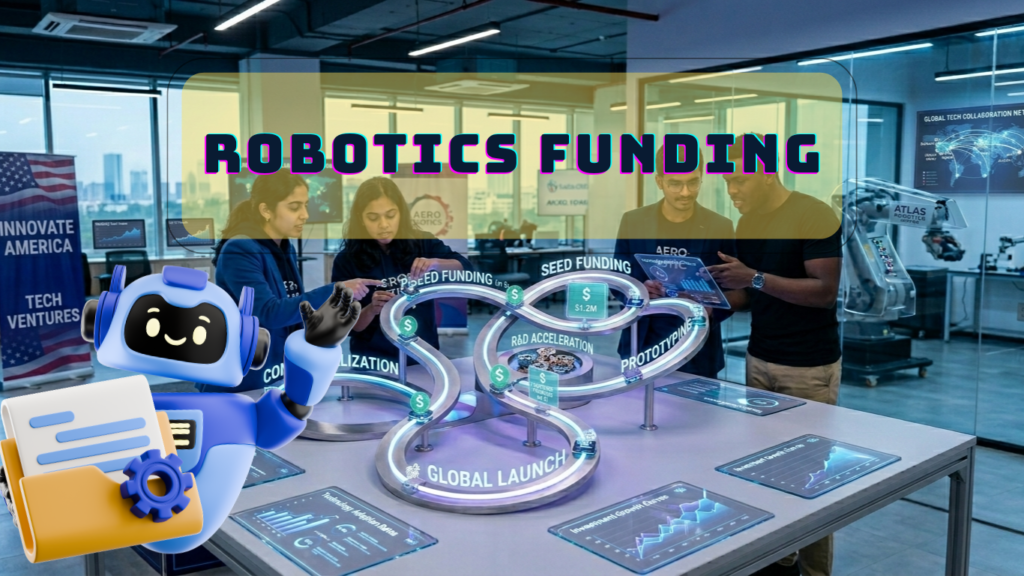
Investors are pouring billions into these technologies because they see a perfect storm of necessity and opportunity. The United States is currently facing a structural labor shortage that neither simple immigration nor training programs can solve on their own. We have a massive aging population retiring from skilled trades, while fewer young people are entering those fields. At the same time, the urgent need to “reshore” manufacturing, bringing factories back to U.S. soil to protect our supply chains, is creating a massive demand for robots to fill the gap. Against this backdrop, this report dives deep into the latest robotics funding news, exploring how venture capital, government grants, and innovative startups are shaping the future of the American economy.
What Is Robotics Funding and Why It Matters
Robotics funding is the fuel driving innovation. It comes from VC firms, private equity, corporate investors, and the government to help startups research, design, and manufacture robots. But it’s more than a bank balance—it’s a “vote of confidence” in specific technologies. When companies like Figure AI or Apptronik raise hundreds of millions, it signals to the market that their automation approach could set the industry standard.
These impacts are not confined to boardrooms or balance sheets, but ripple across every facet of daily life. To fully appreciate the stakes, let’s delve into recent trends and breakthroughs driving robotics funding in the United States and beyond.
| Venture Capital | Private Firms (e.g., CapitalG) | High-growth startups | Market disruption and scaling |
| Government Grants | NSF, DoD, NASA | Fundamental research | National security and innovation |
| Corporate Investment | Google, Mercedes, NVIDIA | Strategic partnerships | Supply chain integration |
| Private Equity | Large asset managers | Mature companies | Operational efficiency |
Robotics Funding News: Key Trends in 2025
Against this backdrop, the sector’s recent growth stands out sharply. The year 2025 was record-breaking for robotics, setting the tone for 2026 as investors doubled down on technologies addressing tangible, real-world needs. This marks a clear pivot from earlier AI ventures and lays the groundwork for the innovations discussed below.
Surge in AI-Powered Robotics Startups
The most significant trend in robot funding news is the sheer scale of investment in AI-driven startups. Investors are no longer interested in robots that just follow a preset script—they want robots that can learn. This shift in investor appetite was clear in February 2026, when the market raised a staggering $62.54 billion across all U.S. venture capital, with 89% of that capital going toward AI-focused companies. While some of these funds went to software giants like Anthropic, a significant portion is now flowing into “Physical AI” firms such as Waymo, which closed a $16 billion round to advance autonomous driving.
Increased Government Support in the U.S.
The U.S. government is treating robotics as a matter of national priority. In the 2026 budget requests, the National Science Foundation (NSF) and the Department of Defense (DoD) have carved out billions for AI and autonomy research. The DoD specifically requested $13.4 billion for autonomy and AI systems, a record-breaking figure that highlights the move toward uncrewed aerial and ground systems. These federal dollars act as “de-risking” capital; they fund basic research that private VCs might deem too risky, eventually leading to commercial products we use in everyday life.
Venture Capital Interest at an All-Time High
We are seeing a “flight to quality” in the VC world. While the broader startup market has normalized, “smart money” is doubling down on robotics platforms with clear commercial use cases. In the first half of 2025, U.S. robotics startup funding jumped by over 75%, largeWe are seeing a “flight to quality” in the VC world. While the broader startup market has normalized, “smart money” is doubling down on robotics platforms with clear commercial use cases. This sharp investor focus became evident in the first half of 2025, as U.S. robotics startup funding jumped by over 75%, largely because investors are looking for alternatives to traditional industrial labor. Major names like NVIDIA, Intel, and Microsoft are no longer just software partners; they are lead investors in companies like Figure AI, because they know that the future of their own silicon chips depends on the robots they will power. It is making so many headlines. The industry is hitting a breaking point, and the data shows that contractors are desperate for solutions. In 2025, construction tech startups pulled in $1.36 billion in venture funding, a massive 125% increase from the previous year.
Why Construction Robotics Is Booming
The “why” is simple: demography. Nearly 41% of the current construction workforce is expected to retire by 2031, while only 10% are under 25. We are losing decades of experience, and there isn’t a pipeline of new workers to replace them. This labor deficit could cost $ 1. The reason is simple: demographics. Nearly 41% of the current U.S. construction workforce, defined as those who are currently employed in construction roles, is expected to retire by 2031. In contrast, only 10% are under 25. This means we are losing decades of experience without a sufficient supply of younger workers to replenish the workforce. If this labor deficit is not addressed, it could result in a $124 billion loss in industrial output. Robots are no longer just a ‘nice-to-have ‘; they are necessary to continue building data centers, highways, and homes that the U.S. economy depends on. $ 75 billion, underscoring investors’ confidence. A few key players are dominating the news on construction robotics funding. One prominent example is Bedrock Robotics, the current “unicorn” of the sector. The company raised $270 million in a Series B round in February 2026, bringing its valuation to $1.75 billion and underscoring investors’ confidence in their “retrofit” model. Instead of asking contractors to buy entirely new, multi-million dollar robots, Bedrock provides a kit that turns an existing excavator into an autonomous machine in a single day. the site.
| Bedrock Robotics | $350 Million+ | $1.75 Billion | Retrofit kits for excavators/dozers |
| FieldAI | $405 Million+ | N/A | AI “software brain” for site robots |
| ICON | N/A | N/A | 3D printing for entire communities |
| Buildroid AI | $2 Million (Pre-seed) | N/A | Simulation-first block-laying |
Real-Life Example: Bedrock and Sundt Construction
This isn’t just theory it’s happening on real U.S. job sites. For example, in the Southwest, Bedrock Robotics partnered with Sundt Construction on a massive 130-acre manufacturing facility project. On this site, autonomous excavators moved over 65,000 cubic yards of earth and rock. Importantly, the robots worked seamlessly alongside human-operated dump trucks, proving that you don’t need to redesign the entire workflow to benefit from automation. As Sundt’s project manager, Dan Green, put it, the robots handle the “monotony of mass excavation,” freeing up their best operators to solve more creative problems. Noid Robots News: The Next Big Investment Wave
If construction robots are the workhorses, humanoids are the “holy grail” of the industry. The news about humanoid robots we are seeing in 2026 feels like something out of a sci-fi movie, but the investment dollars are very real. The global humanoid market is expected to explode from $2.9 billion in 2025 to as much as $38 billion by 2035.
What Are Humanoid Robots?
But what exactly distinguishes a humanoid robot from other automation technologies? Their human-like shape isn’t just a novelty; it’s a strategic design choice that allows for the use of existing infrastructure with minimal adaptation, making them uniquely valuable for widespread deployment.
Why Investors Are Interested
This context explains why investors are increasingly gravitating toward versatile platforms. General-purpose humanoids can perform a wide range of tasks, making them attractive bets compared to robots built for single functions.
Big Players in Humanoid Robotics
The competition is fierce. Against this backdrop, Figure AI currently holds a staggering $39 billion valuation after raising over $1 billion in September 2025. Their “Helix” platform enables robots to reason about their environment in real time, as demonstrated during a year-long pilot at BMW’s Spartanburg plant.
Meanwhile, Apptronik has raised nearly $1 billion to scale its “Apollo” robot, which is already being tested by Mercedes-Benz and GXO Logistics. Apollo is famous for its “hot-swappable” battery system, which allows it to work for 22 hours a day with only brief pauses to change out battery packs.
Role of Arduino in Robotics Innovation
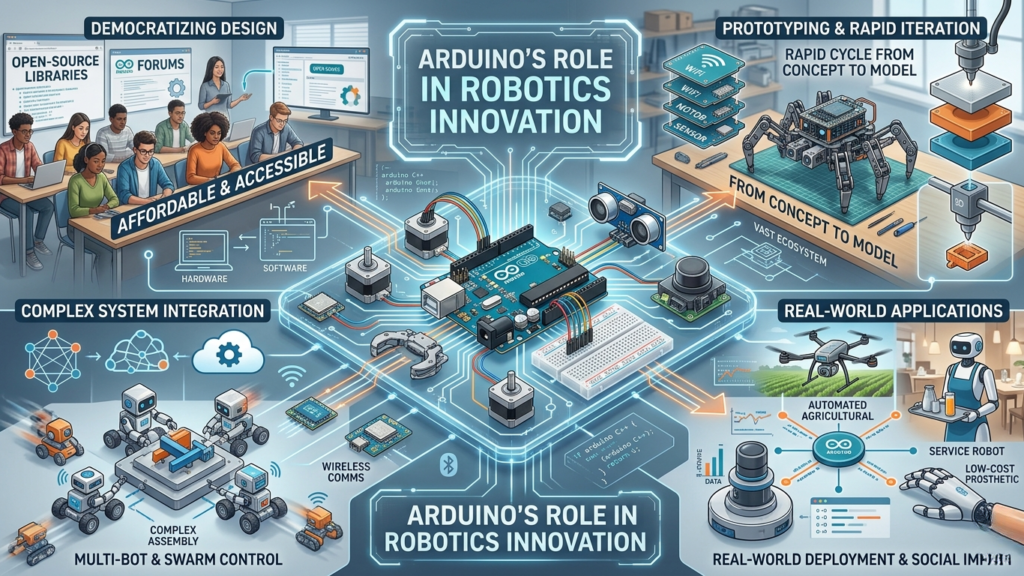
You might think that these multi-billion-dollar companies have nothing in common with hobbyists, but the truth is that many of them started with a simple Arduino board. Arduino is an open-source electronics platform that has democratized engineering. In the world of robo funding news, Arduino is the bridge that turns a “good idea” into a “working prototype” that an investor can actually see and touch.
Why Arduino Is Popular in Robotics
Arduino is the ultimate “low barrier to entry” tool. It’s affordable, easy to program, and has a massive global community that shares code and troubleshooting tips. Whether you’re a student in a STEM program or an engineer at a startup like Cubetto or FarmBot, Arduino allows you to iterate quickly. You can test a new sensor or a motor control algorithm in a matter of hours, rather than weeks.
From Hobby to Startup
Many successful robotics products that have raised millions in funding began as Arduino prototypes. For example, the Smart Citizen Kit and the Touch Board both started as simple Arduino-based ideas before launching successful crowdfunding campaigns and moving into mass production. Even at the enterprise level, giant tech companies like Qualcomm have noticed the platform’s power. Qualcomm recently acquired Arduino to help anchor their strategy for “Edge AI,” launching the new Uno Q board to help developers build smarter robots faster.
Top Industries Benefiting from Robotics Funding
While manufacturing is the obvious winner, the “robotics revolution” is touching almost every part of the U.S. economy.
- Logistics & E-commerce: This is the largest current market, accounting for 39% of the robotics industry. With the explosion of online shopping, companies like Amazon and GXO are using autonomous mobile robots (AMRs) to move inventory 24/7.
- Healthcare: Surgical robots and “social humanoids” are helping to alleviate the pressure on our nursing staff. Robots like Diligent Robotics’ Moxi are already helping hospital teams with non-patient-facing tasks.
- Agriculture: Startups like FarmWise are developing robots that can pull weeds without pesticides, helping create a more sustainable food supply.
- Infrastructure: Drones from companies like Infravision are transforming how we build and maintain the power grid, stringing power lines faster and more safely than human crews.
Challenges in Robotics Funding
It’s not all sunshine and rainbows; building robots is incredibly difficult. There are several hurdles that even the most well-funded startups must overcome:
- Technical Complexity: Human environments are “messy.” A robot that works perfectly in a lab might fail if a warehouse aisle is slightly cluttered or the lighting changes.
- Energy Density: Most humanoid robots only have a battery life of 2-4 hours before needing a charge. This makes long-term autonomous work a challenge.
- Safety & Regulation: As robots move out of “cages” and start working alongside humans, the safety requirements become much stricter.
- The “Teleoperation” Problem: Many flashy videos you see online are actually “teleoperated,” meaning a human is controlling the robot remotely. Truly autonomous operation is much harder to achieve.
Future Outlook: Where Robotics Funding Is Heading
Looking ahead to 2030, the robot funding news will likely shift from “how do we build this?” to “how do we scale this?” We are moving into the era of the “Generalist Robot.” We expect to see “dark warehouses”—facilities that run 24/7 without lights, operated entirely by autonomous fleets. We will also see robots moving into the home, helping with everything from folding laundry to cooking dinner.
The U.S. is currently in a “new space race,” according to Apptronik CEO Jeff Cardenas. The country that masters Physical AI will have a massive economic and strategic advantage for the next century.
FAQs
Q: What is the biggest robotic funding news of 2026? A: The most significant robot funding news is the massive $30 billion funding for Anthropic and $16 billion for Waymo, alongside Figure AI’s $39 billion valuation and Apptronik’s $520 million Series A extension.
Q: How do construction robots help with labor shortages? A: Construction robots, like Bedrock’s autonomous excavators, handle repetitive tasks such as mass earthmoving. This allows a limited human workforce to focus on high-skill problem-solving, helping to bridge the gap left by retiring workers.
Q: Can I build a professional robot with Arduino? A: While professional industrial robots eventually use custom hardware, almost all of them start with Arduino or similar platforms for rapid prototyping. Arduino is an essential tool for testing your logic before moving to expensive mass production.
Q: Why are humanoid robots so expensive right now? A: Humanoids are in the “pilot and research” phase, which requires massive R&D spending. However, experts project that as production scales, the price could drop to $20,000–$30,000, roughly the cost of a car.
Conclusion
The robotics funding news we’ve explored today shows a clear path toward a more automated, efficient, and resilient American economy. From the massive venture capital rounds in Silicon Valley to the grit of autonomous machines on a Texas jobsite, the “Physical AI” revolution is no longer a future dream it is a present-day reality. Whether you are a business owner looking to automate your workflow or a student learning to code with an Arduino, the opportunities in this field are limitless.




Leave a Reply