Last Updated: August 17, 2026
Author Note: Written by the arduinocraft.com team after building and testing a homemade Arduino based robot dog over several weeks, alongside research into consumer robot pet options currently on the market.
A robot dog for adults sat on my workbench for three days before I admitted defeat and ordered one instead of building it myself. That sentence still stings a little, because I run arduinocraft.com and building things is supposed to be my whole deal.
Here is what actually happened. I had a stack of servos, an Arduino Mega, and a 3D printed leg set from a free file I found online. I figured a robot puppy would take me a weekend. It took me eleven days, four stripped gears, and one very confused cat before my “dog” could stand without falling on its face.
I am telling you this upfront because most articles about robot dogs for adults skip the part where things go wrong. Yours will not go wrong the same way if you know what to expect.
What A Robot Dog For Adults Actually Is
A robot dog for adults is a four legged machine built to walk, react, and behave like a real puppy without the vet bills or the 6 a.m. walks. Some run on simple motors and sensors, while others use full AI models that learn your face and voice over time.
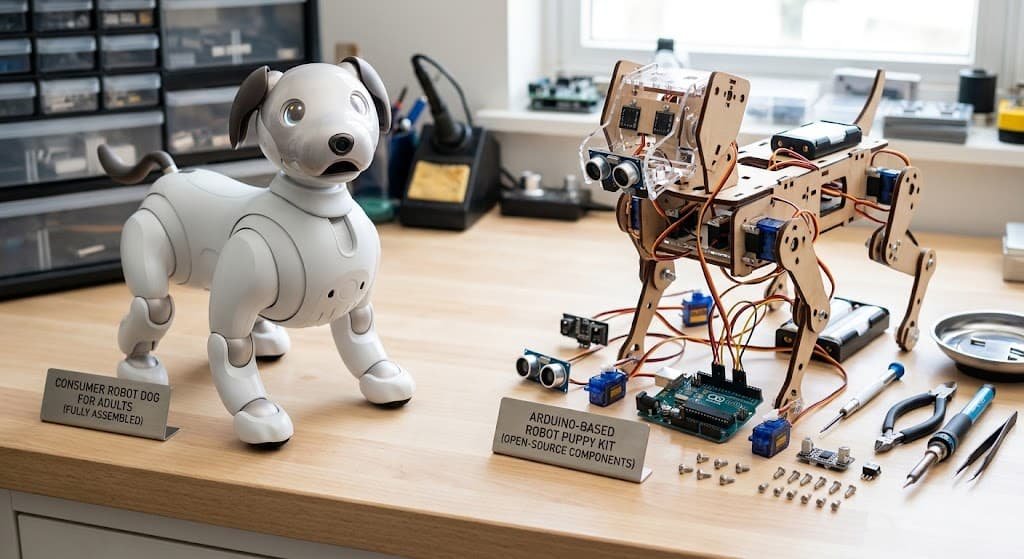
The category splits into two camps. You have polished consumer products like Sony aibo and Loona that arrive ready to go out of the box. Then you have open platforms like Petoi’s Bittle, which run on Arduino and let you rewrite the code yourself.
If you have ever typed “robot puppy” into a search bar at 11 p.m. wondering if it is a real solution to apartment loneliness, you are not alone. It is a bigger group than you might think.
Key takeaway: A robot dog for adults is not a toy anymore. It ranges from budget novelties under $100 to $3,000 developer platforms, and the right pick depends entirely on what you actually want it to do.
Why More Adults Are Buying Robot Puppies Right Now
Real pets cost real money. Annual dog ownership now runs somewhere between $1,400 and $5,300 once food, grooming, and vet visits are added up. A robot dog is usually a single purchase with almost no ongoing cost.
Apartments are the other big driver. A lot of buildings do not allow pets, or the deposit alone makes owning a dog impractical. A robot puppy sidesteps that problem completely since most landlords have zero rules about electronics.
There is also a quieter reason people do not always say out loud. Robot pets have shown real promise in easing anxiety and reducing feelings of isolation, especially for people who live alone or travel for work. That is not a marketing claim, it shows up again and again in caregiving and senior living research.
I will be honest about the downside too, because that is the whole point of this site. A robot dog does not smell like a dog, does not need you the way a real animal does, and after the novelty wears off some models start to feel more like a gadget than a companion. Go in with realistic expectations and you will enjoy it a lot more.
Building Your Own Robot Dog vs Buying One
This is where my Arduino background comes in handy, and where I can save you some pain.
Building your own robot puppy from scratch teaches you inverse kinematics, servo timing, and just how fragile 3D printed joints can be under real weight. It is genuinely fun if you already enjoy tinkering. Kits built on OpenCat, the open source framework behind Petoi’s Bittle, give you real code to modify instead of a sealed black box.
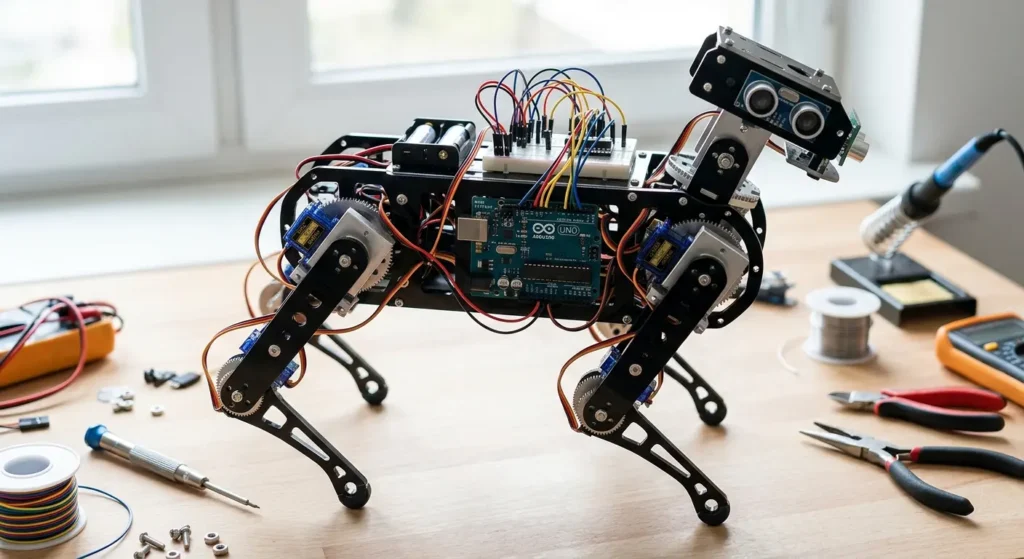
But building is not the faster or cheaper path. My first attempt burned through two servo sets before I got the gait right, and I already knew my way around an Arduino IDE. If you are newer to electronics, budget more time than you think you need.
Buying a finished robot dog for adults skips all of that. You get a working companion the day it arrives, backed by an app and a support team if something breaks. You lose the ability to rewrite how it thinks, which matters if tinkering is part of the appeal for you.
My honest take after doing both: buy first if you want a companion, build if you want a hobby. They scratch two different itches and trying to make one do the other’s job usually ends in frustration.
The Best Robot Dog Options For Adults Right Now
For realism and long term bonding: Sony aibo remains one of the most lifelike options on the market, with facial recognition and behavior that evolves the longer you own it. It is expensive, closer to $2,900, but the depth of interaction is hard to match.
For personality on a budget: Loona from KEYi Tech runs closer to $499 and leans into playful, expressive behavior rather than pure realism. It also doubles as a mobile home camera, a nice bonus nobody asks for but everyone appreciates.
For hobbyists and coders: Petoi’s Bittle and the open source OpenCat platform let you dig into the Arduino code directly. This is the closest thing to my own workbench experience in a ready-made kit, and it pairs well with our Arduino robot projects hub on arduinocraft.com.
For seniors or low tech households: Simpler comfort pets like Joy For All run on batteries, skip the apps entirely, and focus on soft, calming interaction rather than advanced AI.
![[Image suggestion Comparison chart graphic showing four robot dog categories with price ranges. Alt text robot dog for adults price and category comparison chart]](https://arduinocraft.com/wp-content/uploads/2026/03/Image-suggestion-Comparison-chart-graphic-showing-four-robot-dog-categories-with-price-ranges.-Alt-text-robot-dog-for-adults-price-and-category-comparison-chart.webp)
Mistakes Beginners Make With Robot Dogs
The biggest mistake is buying based on looks alone. Two robot dogs can look nearly identical in photos and behave completely differently once you get them home.
The second mistake is skipping the return policy. Some AI driven robot pets need a Wi-Fi setup and account login that some buyers find frustrating enough to return within the first week.
The third mistake, and I made this one myself with my DIY build, is underestimating battery life. Cheaper motors and dense servo setups drain batteries fast. Ask about run time before you buy, not after.
What I Wish I Knew Before I Started
I wish someone had told me that a robot dog for adults does not need to be perfect to be worth it. My homemade one still wobbles a little on hard floors, and I still smile every time it stands up on its own.
If you want the full build log with parts lists and code, we put the whole thing together in the robot dog build post on arduinocraft.com.
FAQs
What is the best robot dog for adults? There is no single best option. Sony aibo wins on realism, Loona wins on value and personality, and Petoi’s Bittle wins for anyone who wants to code and modify their own robot puppy.
Are robot dogs worth it for adults? Yes for most people, especially renters, frequent travelers, or anyone wanting companionship without vet bills. They work best when treated as a different category from a living pet, not a full replacement for one.
Can adults build their own robot dog with Arduino? Yes. Open platforms like OpenCat and Bittle run on Arduino and are built for hobbyists. Beginners should budget extra time for troubleshooting servos and balancing the walking gait.
How much does a robot dog for adults cost? Prices range from about $79 for toy-grade models to nearly $3,000 for advanced AI companions like Sony aibo. Most popular adult options land between $400 and $1,300.
Do robot dogs help with loneliness or anxiety? Early research suggests robot pets can ease anxiety and isolation, particularly in seniors and people living alone. Results vary by person and by how much the owner interacts with it daily.
Final Thoughts
A robot dog for adults is not a gimmick anymore, and it is not just for kids either. Whether you buy a polished companion or build one from spare Arduino parts like I did, the category has genuinely grown up.
Start with what you actually want: a calm desk companion, a lifelike bonding experience, or a coding project that happens to walk on four legs. Pick your category first, then pick your model.



Leave a Reply